
Using Rice Husk and Sawdust Biochar to Improve Soil for Sustainable Vegetable Farming in Northern Ghana
3 min read
ABSTRACT
In sub-Saharan Africa, declining soil fertility and inadequate moisture retention are two of the main obstacles to sustainable vegetable production. This study evaluated the impact of various rates and varieties of biochar, which is made from sawdust and rice husk, on soil moisture and nutrient retention, as well as amaranthus growth and production. In pots, treatments were compared after biochar was added to the soil at different rates (25 and 50%). According to the results, rice husk biochar (RHB), especially when applied at a moderate rate of 25%, greatly increased the availability of soil nutrients, especially nitrogen and potassium, improved moisture retention, and encouraged superior plant growth metrics, such as plant height, leaf area, branch count, stem diameter, and chlorophyll content (SPAD). In the 25% RHB treatment, the maximum biomass output (217.11 g) was observed. Sawdust biochar (SDB), on the other hand, demonstrated few advantages and occasionally performed worse than the control. Results from mixed biochar applications were moderate. These results imply that rice husk biochar is superior to sawdust biochar in terms of enhancing soil quality and increasing amaranthus productivity, particularly when applied at lower rates. Through improved soil health and carbon sequestration, the study highlights the potential of biochar in climate-smart practices and sustainable agriculture.
Problem Statement
Agriculture in Ghana’s Savannah Zone, like many parts of sub-Saharan Africa, faces increasing challenges due to climate change, declining soil fertility, and water scarcity. Rapid population growth has intensified land cultivation, often without restoring soil nutrients or structure, resulting in degraded soils with poor organic matter, limited microbial activity, and low moisture retention. Traditional solutions like chemical fertilizers are often too expensive for smallholder farmers and contribute to environmental issues such as water pollution and greenhouse gas emissions.Biochar—produced by pyrolyzing agricultural residues like rice husk and sawdust—has emerged as a promising, low-cost soil amendment. It enhances soil fertility, boosts microbial activity, retains moisture, and improves overall crop productivity while offering carbon sequestration benefits. However, despite its potential, biochar adoption in Ghana remains low, especially for vegetable crops like Amaranthus, a widely grown and nutritionally important leafy vegetable for smallholder farmers.Most research has focused on cereals such as maize and rice, with limited field-based evidence on how different biochar types and application rates affect the growth and yield of Amaranthus.
Moreover, few studies have compared rice husk and sawdust biochar side-by-side under real field conditions. There’s also limited integration of soil chemistry with plant physiology in biochar research—many studies assess soil or crop parameters independently, missing the link between improved soil health and actual yield outcomes.Water availability is a key constraint in rain-fed farming systems. Biochar’s high porosity has been shown to improve soil moisture retention, which is critical for crops like Amaranthus that are sensitive to drought. However, it’s still unclear how rice husk and sawdust biochar differ in their ability to improve soil moisture and plant performance under field conditions.Therefore, there is a need for region-specific, field-based research to evaluate and compare the effects of rice husk and sawdust biochar—at varying application rates—on the growth, yield, and water use efficiency of Amaranthus. Such data will support the development of practical, cost-effective recommendations for smallholder farmers and promote sustainable vegetable production in Northern Ghana.
RESULTS
BIOCHAR EFFECT ON SOIL CHEMICAL PROPERTIES
Applying sawdust and rice husk biochar significantly improved soil nutrient levels compared to the control. The 25% rice husk + 75% soil treatment recorded the highest levels of nitrogen and potassium, while other treatments showed peaks in calcium, phosphorus, and magnesium, depending on the biochar type and mix. Overall, rice husk biochar, whether used alone or in combination, proved most effective in enhancing soil fertility.
| Treatment Description | N (%) | P (mg/kg) | K (cmol/kg) | Ca | Mg |
| Control | 0.1822 | 5.48 | 4.106 | 8.879 | 5.227 |
| 50% rice husk + soil | 0.2178 | 8.24 | 5.803 | 9.966 | 4.254 |
| 50% sawdust + soil | 0.1891 | 6.24 | 4.36 | 14.85 | 4.984 |
| 25% rice husk + 75% soil | 0.2716 | 7.26 | 8.914 | 10.37 | 4.254 |
| 25% sawdust + 75% soil | 0.1925 | 7.30 | 4.065 | 11.54 | 4.254 |
| 25% rice husk + 25% sawdust + 50% soil | 0.2166 | 5.82 | 6.964 | 13.33 | 6.199 |
BIOCHAR EFFECT ON PLANT GROWTH AND YIELD
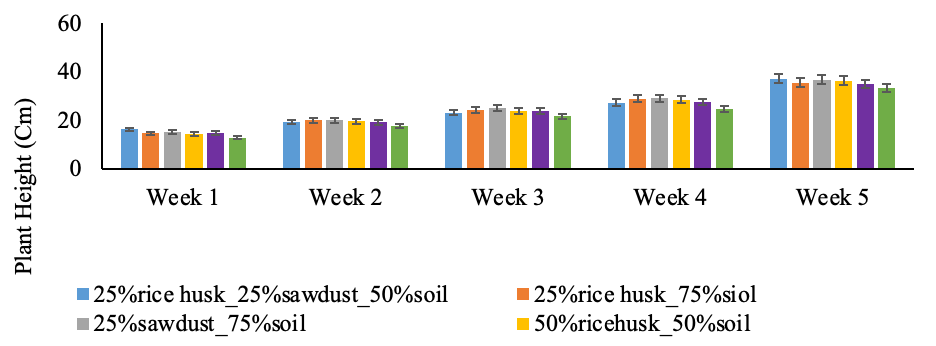
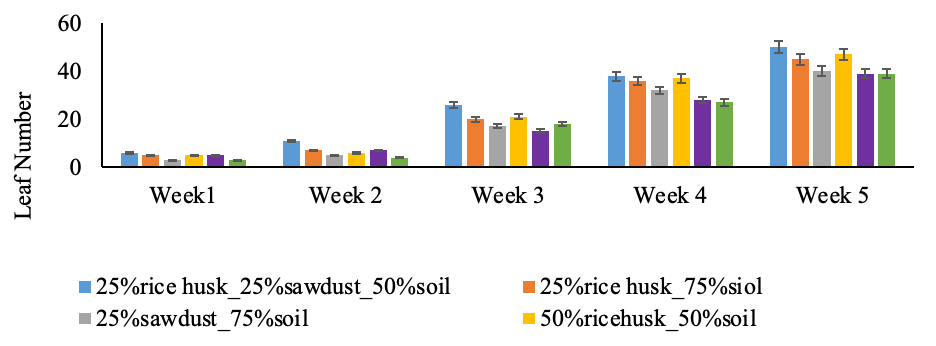
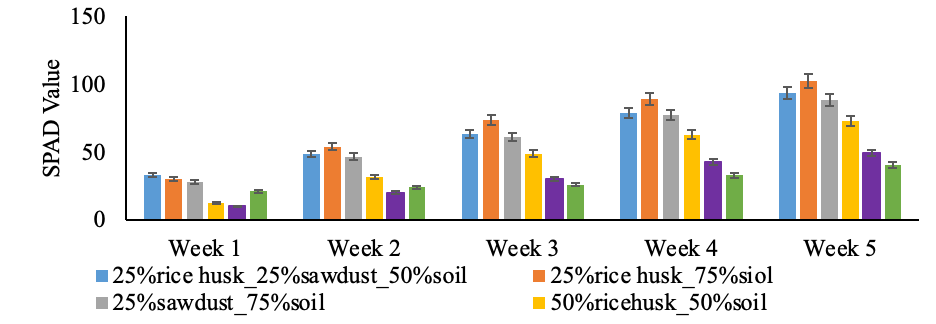
The treatments significantly affected Amaranthus growth (P = 0.0248), with the tallest plants recorded in the 75% soil + 25% rice husk biochar treatment. Other rice husk-based treatments also increased plant height compared to the control, while sawdust biochar alone showed less effect. This suggests rice husk biochar is more effective than sawdust biochar in promoting vertical plant growth.
More projects
 Projects
Enhancing Soil and Plant Health for Sustainable Crop Production Through Biochar-Endophyte Synergy in the Savannah Zone of Ghana
Phase 2 of the Food Ensure Ghana Project Title: Enhancing Soil and Plant Health for Sustainable Crop Production Through Biochar-Endophyte Synergy in the Savannah Zone of Ghana Background Following the successful…
Read more Projects
Synergistic effect of rice husk biochar and endophyte (bioensure and biotango) application on nutrient uptake and nutritional composition of amaranthus
Amaranthus and other vegetable crops are grown by small-scale farmers in Ghana’s northern area, where a variety of chemical fertilizers are also used to enhance the plants’ nutritional makeup and nutrient intake. The…
Read more Projects
AC Research Services and YUAPART Africa Partner to Drive Sustainable Development
AC Research Services (ACRS) and YUAPART Africa teams-up to collaborate on research, capacity building, and evidence-based solutions for sustainable development, particularly in Africa. YUAPART Africa is a youth-driven…
Read more